
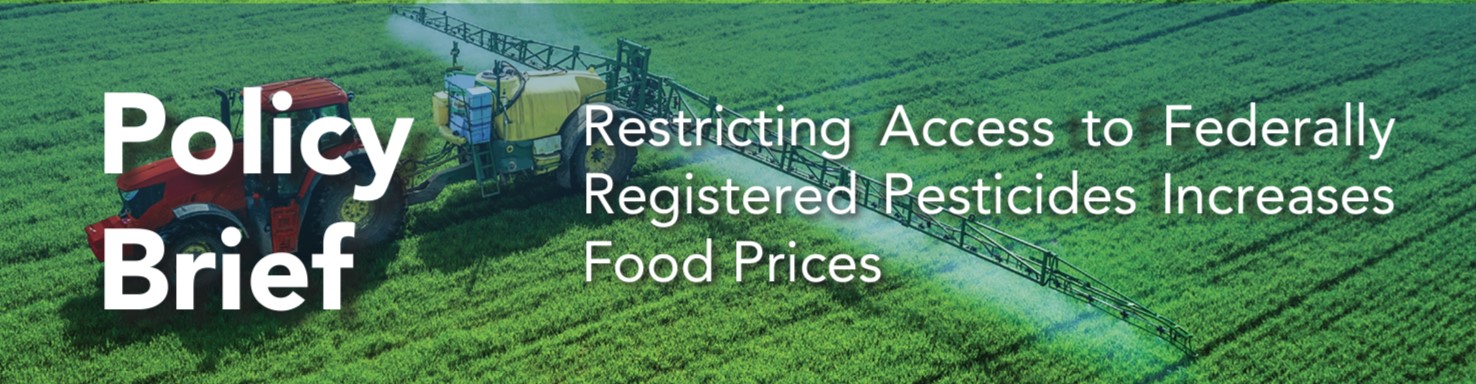
STUDY SHOWS INCREASED FOOD PRICES FROM POTENTIAL STATE ENVIRONMENTAL POLICIES
A 2022 economic analysis study by the California Bountiful Foundation, the 501(c)(3) of the California Farm Bureau found that placing use restrictions on two commonly used pesticides will increase food prices.
KEY FINDINGS
Pesticides are chemicals or biological agents used to control pests such as insects and weeds that damage agricultural crops, keep food prices low, and provide food security.
Pesticides are important tools for growers in protecting the agricultural food supply from insect pests similar to controlling house pests and weeds.
Removing pesticides from the registered list by State and Federal environmental agencies will increase food prices.
Existing pesticides control a broad spectrum of insects with low levels of applications.
There are few or no alternatives for those being removed for use.
Pesticide alternatives, to those that get removed, may result in greater environmental impacts as a result of higher levels of applications and increased frequency given their lower potency.
Growers use pest control products carefully through a process called Integrated Pest Management to not harm the environment and in consultation with trained professionals called Pest Control Advisors.
The study evaluated what would happen to Romain lettuce prices if two classes of pesticides (pyrethroids and neonicotinoids) were to be removed for use in California agriculture. The study was funded by Californians for Smart Pesticide Policy.
The results showed:
- Consumer prices will increase 8.22% for romaine lettuce.
- Increased costs to growers that are between $230 to $290 per acre.
- 5-30% crop yield losses
- Few or no alternative pest control tools for growers.
- Disproportionality impact lower-income families; since they spend more on food.
- Loss of 420 jobs–$42.9 million in total gross output value loss.
- There will be leakage (growers will move to neighboring States where the pesticides can be used)
THE BIGGER PICTURE
- Restricting pest control tools for growers will result in higher consumer food prices.
- The study was done on the removal of two pesticide classes and one crop.
- Food prices will increase even more since these pest control tools are used on other agricultural food crops.
- Pesticide restrictions are used as a policy to satisfy environmental interests.
- Current pesticide policies are following a European policy making trend where evidence is not needed to establish a policy.
- This is in sharp contrast to evidence-based scientific policy historically used in the U.S.

Such policies hurt the very people (socially disadvantaged communities) that the policies are trying to help since the policy will increase food prices and these same people spend more of their income on basic necessities such as food.
These pesticides are effective at low levels of use and impact a large amount of pests. Other alternatives pest control tools means potentially higher amounts of pesticides and increased frequency of applications which will subsequently result in more tractor use, increased fuel use, increased cost to growers and consumers, and more greenhouse gas emissions.
Growers and companies will move out of State as a result of California restrictions resulting in loss of rural jobs and reduced economic growth in the State.
These policies, if implemented, will impact California agriculture which leads the nation in food production and food security.

To learn more, please contact:
Amrith Gunasekara, PhD, Director of Science and Research
California Bountiful Foundation
agunasekara@CFBF.com
Chris Reardon, Director of Governmental Affairs
California Farm Bureau Federation
creardon@cfbf.com



.svg.png?cacheid=0.9616018850896426)